
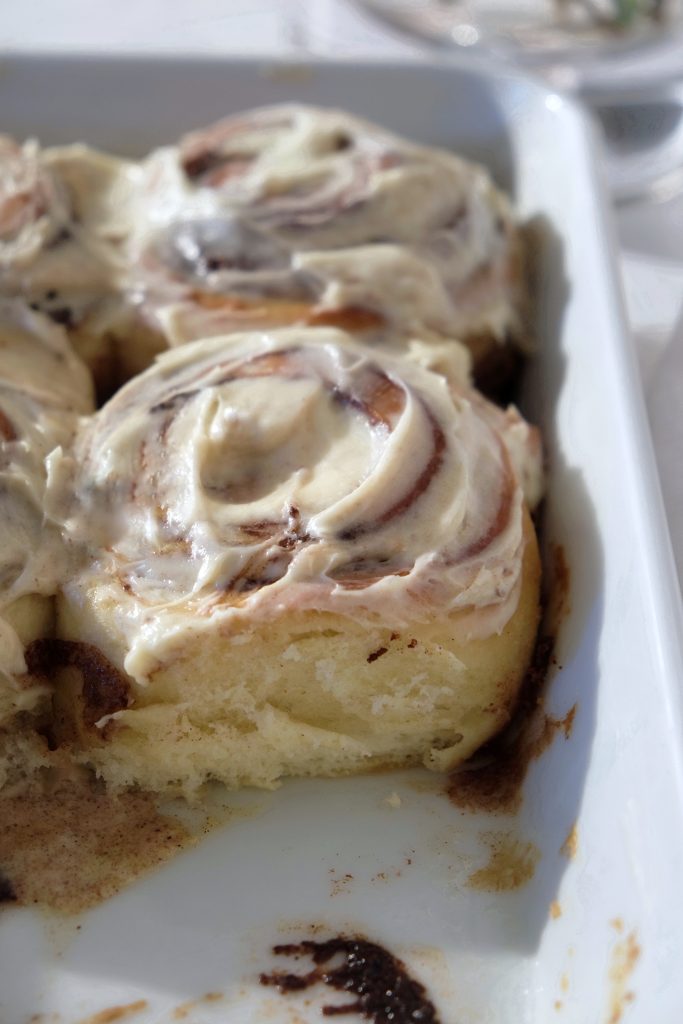
Did you know homemade cinnamon rolls are easy to make and absolutely worth the effort? The key to creating these heavenly, fluffy cinnamon rolls lies in using bread flour and heavy cream – two ingredients that make a world of difference in the final product. And let’s not forget about the creamy, sweet frosting that takes these cinnamon rolls to the next level. As if this wasn’t already a win, you can prep these cinnamon rolls the night before and bake them the following morning. Brunch just got a whole lot better.

Ingredients You’ll Need & Why It Works:
Cinnamon Roll Dough —
Whole Milk: Milk is an essential ingredient in making cinnamon rolls. It is composed of 87% water, which helps bind the gluten proteins in the flour, creating a strong gluten network in the dough. The addition of milk also contributes to the rolls’ golden hue, delays staling, increases their softness, and provides richness in flavor. Since the milk helps to carry the taste and texture of these cinnamon rolls, it is highly recommended to use whole milk, though 2% milk can also be used as a substitute.
Unsalted Butter: Softened unsalted butter adds flavor and helps to incorporate it evenly into the dough, resulting in softer and more fluffy cinnamon rolls.
Bread Flour: Bread flour contains higher amounts of glutenin and gliadin, two essential proteins for forming gluten. When liquid, such as milk, is added to the flour, these two proteins bond together to form gluten. As you knead the dough, the gluten network becomes stronger, helping to trap air bubbles between the structured walls of your gluten and aiding in its leavening. When done correctly, your dough will rise and double in volume after resting for a few hours. So, for fluffy, soft cinnamon rolls, use bread flour. All-purpose flour can be used as a substitute when you’re in a pinch.
Granulated Sugar: The primary purpose of sugar in this recipe is to accelerate the yeast activity, resulting in faster growth and rising of the dough. Some other benefits of sugar include adding sweetness and helping to maintain the softness and tenderness of these cinnamon rolls.
Egg: The addition of an egg helps to combine fats and liquids, improves flavor, provides structure, and contributes to the browning process of these cinnamon rolls, known as the Maillard reaction.
Instant Yeast: Instant yeast comes in smaller granules than active dry yeast. It absorbs liquids rapidly so it can be added directly into the liquids of the dough, or in this case, the warm milk. More importantly, this type of yeast helps these cinnamon rolls to rise faster than active dry yeast. Before starting the dough, check whether your yeast is still good or has staled. Stale or expired yeast will not give rise to your cinnamon rolls.
Table Salt: Salt plays a vital role in this recipe as it controls the rate of rise in the dough, adds flavor, and strengthens the gluten. I prefer table salt because it’s smaller in crystals and will dissolve more uniformly.
Heavy Cream: Due to its high milk-fat ratio and about 60% water content, heavy cream provides additional richness and moisture to these cinnamon rolls. Pouring it on top of the cinnamon rolls after the final rise but before baking creates wonderfully rich, moist, and gooey cinnamon rolls.
Cinnamon Butter Paste —
Light Brown Sugar: Light brown sugar gets its distinct flavor from the molasses added to granulated sugar. This type of sugar is perfect for adding moisture and imparts a caramel flavor to these cinnamon rolls. If brown sugar is not readily available, mix one cup of granulated sugar with one tablespoon of molasses. Be sure to mix thoroughly until the two are fully combined.
Unsalted Butter: For best results, use softened, unsalted butter for this step. This will make it easier to combine the brown sugar and cinnamon. Once fully incorporated, the mixture should take on a paste-like consistency.
Cinnamon: I prefer using Ceylon cinnamon for several reasons. Its flavor and aroma are much milder and sweeter than cassia cinnamon. Ceylon is also regarded as the “less harmful” cinnamon, as it contains lower levels of coumarin. This compound naturally occurs in all cinnamon and can be toxic to the liver when taken in large quantities.
Cream Cheese Frosting —
Cream Cheese: Full-fat cream cheese works best here. Allowing the cream cheese to reach room temperature is essential to avoiding potential lumps in the frosting.
Unsalted Butter: Softened, pliable unsalted butter works best here.
Powdered Sugar: Powdered sugar, or confectioner’s sugar, is sucrose crystals milled into a powder. It also typically contains about 3% of cornstarch or tapioca starch. Powdered sugar containing cornstarch is considered the conventional variety, and the organic variety typically contains tapioca starch. These starches are added to powdered sugar to help absorb moisture (anti-caking) and aid in thickening. When incorporated into frosting, it aids in sweetening and thickening. To achieve a silky smooth frosting, sifting powdered sugar is essential. As always, you can adjust the sweetness level based on your preference.
Vanilla Extract: Vanilla extract enhances the other flavor nuances in the cream cheese frosting.
Whole Milk: Whole milk adds flavor and helps to thin out the thickness of the cream cheese frosting, as it becomes more pliable to spread onto the cinnamon rolls.
Tips for Making Cinnamon Rolls:
Flour Type — While many cinnamon roll recipes suggest using all-purpose flour, I discovered that bread flour was key for making these cinnamon rolls. The increased protein content in bread flour helps the dough to form a sturdy gluten network, resulting in fluffy and light cinnamon rolls.
Yeast & Salt — When incorporating the yeast and salt into the dough mixture, add them on opposite sides of the bowl. Salt inhibits yeast growth, so if you sprinkle salt directly on your yeast, your cinnamon rolls may not rise properly.
Kneading The Dough — Knead the cinnamon roll dough for 8 minutes to ensure proper gluten formation. This step will create a strong gluten network that traps air bubbles and aids in the rising of these cinnamon rolls.
Warm Milk — The milk should be warmed to a temperature between 115°F-120°F. This is the ideal temperature for activating the instant yeast. It’s important to note that if the milk is not sufficiently warm, the yeast will not activate, and if it’s too hot, it will kill the yeast.
Proof & Rest Dough — Resting the dough for 2 hours allows the gluten to relax and develop. The gluten must become elastic and strong enough to trap gas as the dough expands and rises.
Clean Cinnamon Roll Cuts — Dental floss is a helpful tip for clean-cut cinnamon rolls. If you don’t have floss on hand, a sharp knife can also be used.
Storing & Freezing Instructions for Cinnamon Rolls:
Storing Cinnamon Rolls:
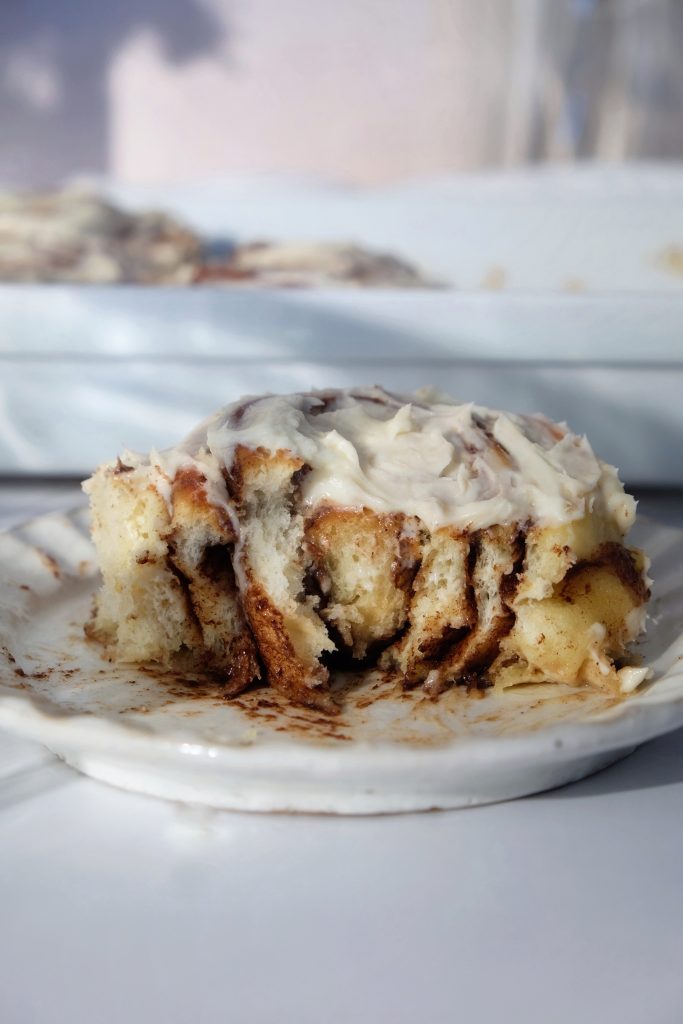
Cinnamon rolls will remain fresh for up to 3 days when stored in an airtight container. Although unnecessary, refrigerated cinnamon rolls can stay good for up to 5 days.
Freezing Cinnamon Rolls:
There are a few ways to freeze cinnamon rolls. For the first method, follow the recipe until step #4, just before the second rise. Place the cinnamon rolls in a freezer-safe container, cover, and freeze. Remember to label the container with the name and date, as they can be frozen for up to 3 months. When ready to bake, transfer the cinnamon rolls to a baking pan and thaw them overnight in the fridge. Let the cinnamon rolls sit at room temperature for 1-2 hours the next day to rise. Then, prepare the cream cheese frosting as instructed in the recipe.
The second method is to partially bake the rolls for 10 minutes at 375°F after the second rise. Take the cinnamon rolls out of the oven and let them cool completely. Wrap them tightly in parchment paper and foil, then freeze. When ready to bake, move the cinnamon roll(s) to the fridge to thaw overnight. Bake them for 10 minutes the following day and prepare the cream cheese frosting.
Recipe Notes:
To make these cinnamon rolls a day in advance, follow the recipe until you get to the 2nd rise (step #4); skip this step. Wrap and place the cinnamon rolls into the fridge overnight. Before baking the following morning, take them out of the fridge and allow them to rise on the counter for 1-2 hours. Bake the rolls as instructed. While the rolls are baking, you can make the cream cheese frosting.
The optimal time to leave the cinnamon rolls in the fridge is between 8 to 12 hours; the max is 16 hours since it’s a yeasted dough. Otherwise, the gluten formation will start to break down. For best results, try to stay within this timeframe.

Cinnamon Rolls
Equipment
- Stand mixer
- Rolling Pin
- 8" baking pan
Ingredients
Cinnamon Roll Dough
- 220 ml whole milk warmed
- 4 tbsp unsalted butter room temperature
- 400 g bread flour divided (1st set – 120g, 2nd set – 280g)
- 75 g granulated sugar
- 1 large egg
- 8 g instant yeast
- 6 g table salt
Cinnamon Sugar Paste
- 100 g light brown sugar
- 2 tbsp ground cinnamon
- 6 tbsp unsalted butter room temperature
Cream Cheese Frosting
- 8 oz cream cheese room temperature
- 1/2 cup unsalted butter room temperature
- 100 g powdered sugar sifted
- 2 tsp vanilla extract
- 20 ml whole milk
Additional Before Baking
- 1/4 cup heavy whipping cream
Instructions
Cinnamon Sugar Paste —
- Combine light brown sugar, cinnamon, and softened butter in a medium-sized bowl. Mix until the ingredients form a paste-like texture. Set aside.
Cinnamon Roll Dough —
- Warm the milk in the microwave until it reaches a temperature of 115°F – 120°F. In the bowl of a standing mixer fitted with the paddle attachment, beat the warm milk, sugar, egg, yeast, salt, and the first set of flour (120g) on low speed until smooth for 3 minutes.
- Next, slowly add softened butter in 3 additions. Mix for another few minutes until the butter is no longer visible. Add the 2nd set of flour (280g). Mix until the dough starts to pull away from the bowl, then switch to a kneading hook.
- Knead the dough for 8 minutes on medium-high speed. The dough should form into a ball and be slightly sticky. However, if it's too sticky, add 1 tbsp of flour. Once done, transfer the dough to a lightly oiled bowl. Cover with a warm towel and proof dough for 2 hours in a warm, draft-free area.
- After the dough has doubled, lightly dust flour onto a work surface and roll the dough out into a 14 "x 14" rectangle. Spread the cinnamon sugar paste evenly over the dough. Tightly roll the dough into a log, ensuring the seam ends on the bottom. Cut off about 1" off the ends. Next, cut six even pieces using a sharp knife or dental floss. Place them into a baking pan. Cover and proof for another 45 minutes. If not baking immediately, see recipe notes for further instructions.
- Preheat oven to 375°F. While the cinnamon rolls are getting their last rise, it's time to make the cream cheese. Using a hand mixer, beat softened cream cheese and unsalted butter in a mixing bowl until smooth, a few minutes. Next, add sifted powdered sugar, vanilla extract, and milk. Beat until smooth and creamy. Chill in the fridge for 15 minutes.
- After the final proofing, pour warm heavy cream evenly onto the cinnamon rolls. Bake for 18-20 minutes. Allow to cool for 20 minutes before smothering on a generous layer of cream cheese frosting onto cinnamon rolls. Devour.



Leave a Reply